World models: how a machine imagines the dig.
A world model is a learned simulation that lets an autonomous excavator predict what the terrain will look like after an action, before it takes that action. Perception tells the machine what the ground is. A world model tells it what the ground will become. In excavation, where every scoop reshapes the surface for the next one, that ability to imagine consequences is the difference between digging and mining.
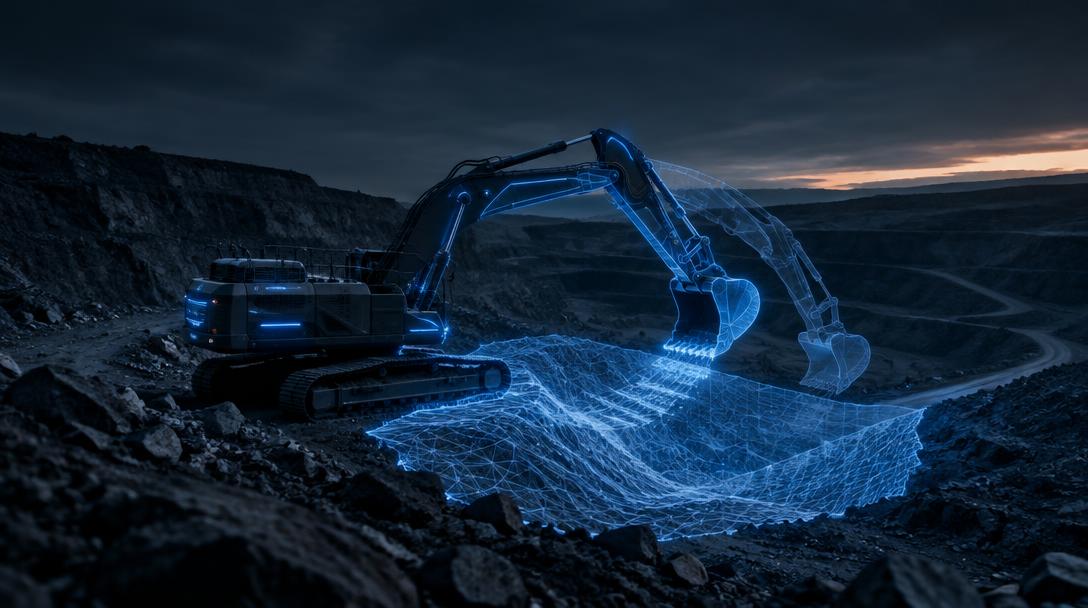
Seeing the ground is not enough. The ground changes.
Most robots act on a fixed world: a warehouse floor, a road, a factory cell. An excavator destroys its own map with every pass. Material spills, slopes steepen, buried rock surfaces, and a face that was stable a minute ago can slump.
A purely reactive system sees each new state only after it has caused it. That is slow, wasteful, and occasionally dangerous. A machine with a world model runs the dig in its head first, tries several options, and commits only to the one whose predicted outcome is best.
This is the layer that sits directly above autonomous perception, and it is where excavation robotics research is now concentrated.
Observe, imagine, rank, correct.
Encode the current terrain
Perception output, from lidar point clouds to regolith classes, is compressed into a compact internal state: the machine's working picture of the ground in front of it.
Predict the post-dig surface
For each candidate action, the model forecasts how the terrain will look after the scoop: new slope angles, spill, collapse risk, and material recovered.
Choose the best consequence
Imagined outcomes are scored on yield per kilowatt-hour, slope stability, and wear. Only the winning action is executed in the real world.
Compare and update
After the dig, the real surface is scanned and compared with the prediction. The error becomes training signal, so the next forecast is sharper.
The Moon is mapped. The dig is not.
Orbital surveys tell us where the resources are. They cannot tell a machine how a given slope of regolith will behave when a bucket cuts into it. That knowledge comes from thousands of real digs, and the place to gather them affordably is Earth.
Every scoop in a quarry or open-pit mine is a prediction followed by a measured outcome. Explural's terrestrial excavation program turns that stream into training data, maturing world models that improve yield, reduce wasted energy, and keep slopes safe. The same models carry forward to any site where autonomy has to work without a human in the loop.
Better predictions mean fewer wasted passes, and fewer wasted passes mean more material per unit of energy. That ratio is what decides whether in-situ resource utilization becomes self-sustaining.
Keep exploring.
How space propulsion works: a complete guide
Chemical, ion, nuclear, and beyond, the engines that move spacecraft, explained from first principles.
Read →
Living off the land on the Moon: an ISRU guide
How missions mine water, oxygen, fuel, and metals from lunar regolith instead of launching them from Earth.
Read →
Tritium vs. helium-3 for fusion energy
How the two leading fusion fuels compare on scarcity, yield, and why the Moon settles the debate.
Read →