How space propulsion works.
Every spacecraft moves by throwing mass one way to travel the other, but the engines that do it range from violent chemical rockets to whisper-quiet ion drives and reactor- powered thrusters. This guide explains how each class works, the two numbers that define them, and why no single engine wins every mission.
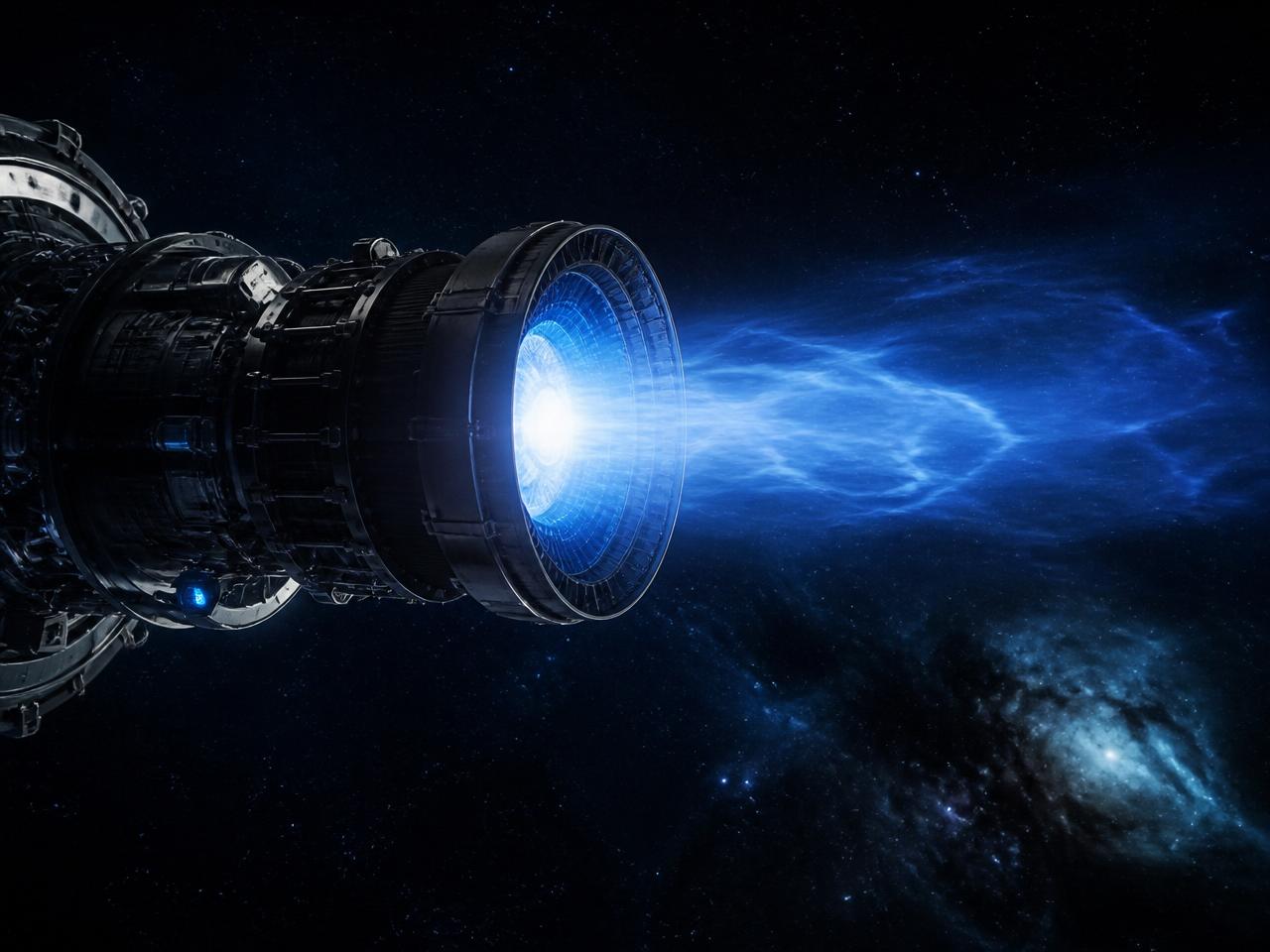
Two numbers govern every engine: thrust and specific impulse.
Propulsion in space obeys one rule, Newton's third law. To accelerate, a vehicle hurls reaction mass (propellant) backward; the equal and opposite reaction pushes it forward. There is no air to push against, so everything comes down to how much mass you throw and how fast you throw it.
Thrust is the instantaneous force an engine produces, what gets you off a launch pad. Specific impulse (Iₛₚ) measures efficiency: how much push you extract per unit of propellant, expressed in seconds. The painful truth of rocketry is that these two usually trade against each other. Chemical engines deliver enormous thrust but burn through propellant; electric engines are extraordinarily efficient but produce force no greater than the weight of a sheet of paper.
That tension, captured by the Tsiolkovsky rocket equation, is why mission designers match the engine to the job: brute force to escape gravity, then patient efficiency for the long cruise.
Every major engine type, side by side.
The next leap is decoupling energy from propellant.
Chemical rockets will keep dominating launch, no other technology matches their thrust-to-weight at sea level. But once you reach orbit, the calculus flips, and the future belongs to engines that carry their energy source separately from their reaction mass.
Nuclear and fusion-electric propulsion are the clearest path. A reactor supplies near-limitless power to high-efficiency thrusters, so a spacecraft can keep accelerating for months instead of minutes. That changes the map: weeks to Mars instead of years, and the outer solar system within practical reach.
At Explural, propulsion and fuel research move together, securing the fusion isotopes that make high-power electric drives possible, and engineering the systems that turn that energy into sustained thrust beyond Earth.
The Deep-Space Propulsion Primer.
A concise PDF reference covering every major propulsion class, chemical, electric, nuclear, and emerging concepts, with the thrust, efficiency, and trade-offs that decide which engine flies which mission. Enter your email to get the guide.
Keep exploring.
Living off the land on the Moon: an ISRU guide
How missions mine water, oxygen, fuel, and metals from lunar regolith instead of launching them from Earth.
Read →
Tritium vs. helium-3 for fusion energy
How the two leading fusion fuels compare on scarcity, yield, and why the Moon settles the debate.
Read →
Extracting helium-3 from lunar regolith
The thermal volatilization process and the economics of mining fusion fuel from lunar soil.
Read →