AI-Cosmoindustry: the Quiet Expansion.
Getting to space is now a solved problem. Staying there is not. The next civilization-scale shift is AI-cosmoindustry: autonomous systems that mine, process, manufacture, and maintain an off-world industrial base without a human operator in every loop. This is the technology that turns a lunar outpost into a self-sustaining presence.
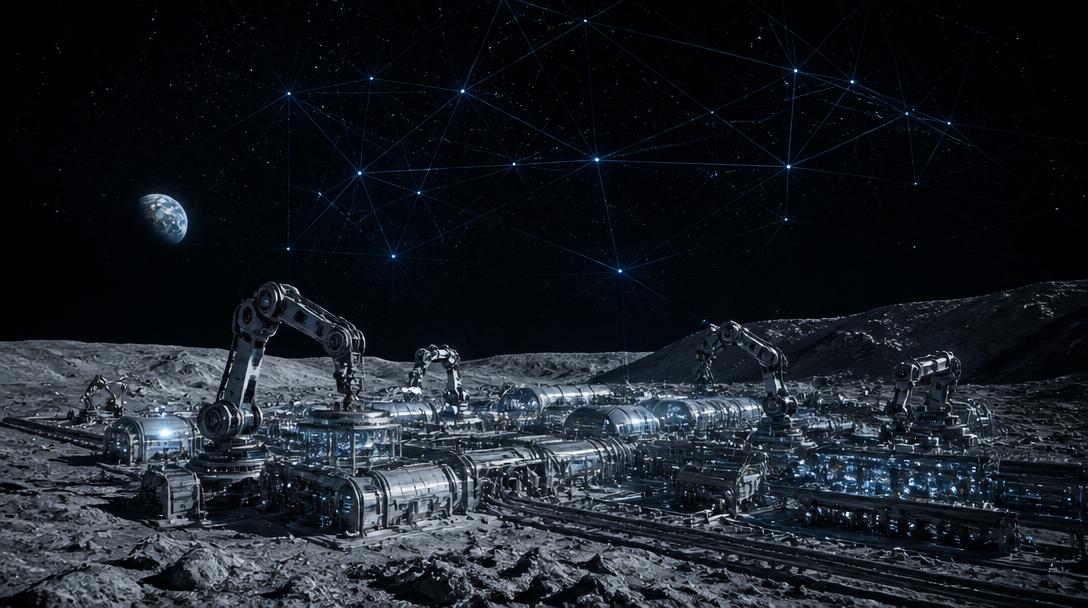
Technology is a cost effective strategy.
Every kilogram shipped from Earth to the Moon costs orders of magnitude more than the same kilogram sourced locally. The math only works if the destination can produce its own fuel, water, air, and structures. But production off-world cannot rely on a technician in every loop, latency, radiation, and cost make that impossible.
AI closes the gap. A machine-learning model can monitor a reactor, adjust a dig path, or rebalance a life-support loop from Earth or from orbit. Robotics executes the decisions locally. The result is a factory that keeps running while humans sleep, in locations humans do not yet inhabit.
This is why AI is not a side project for space companies. It is the operating system of any self-sustaining presence. Without it, space remains a place to visit. With it, space becomes a place to grow.
Four layers of autonomous off-world industry.
Sensors & orbital data
Satellites, rovers, and drones map terrain, composition, and ice deposits before a single shovel breaks ground.
Planning models
AI agents turn maps into dig plans, process schedules, and logistics routes that adapt to equipment health and changing conditions.
Robotic systems
Robotic excavators, reactors, and 3D printers execute the plan while streaming telemetry back for continuous optimization.
Closed-loop control
Waste from one process becomes feedstock for another. Predictive models keep air, water, and power loops balanced with minimal human oversight.
Population, resources, and the long view.
Human population and economic growth increase demand for energy, minerals, and habitable capacity. Earth is not infinite. The most responsible path forward is not to extract more from a single planet, but to diversify the industrial base into space, where energy and raw materials are abundant and the environmental cost of extraction can be offloaded from fragile ecosystems.
The quiet expansion idea suggests that advanced civilizations do not expand loudly, they build resilient, distributed, self-sustaining systems. AI-cosmoindustry is how we do that practically: seed factories that can maintain, repair, and replicate enough function to keep human presence alive even when supply lines from Earth are long or interrupted.
At Explural, this is the unifying thesis behind every program. AI-guided excavation on Earth trains the control stack for lunar regolith mining. Closed-loop carbon and water systems prototype life-support intelligence. Fusion-fuel research identifies the energy source that makes it all viable. Each line of work is a module in the same system: an AI-operated resource layer for cislunar space.
Keep exploring.
How space propulsion works: a complete guide
Chemical, ion, nuclear, and beyond, the engines that move spacecraft, explained from first principles.
Read →
Living off the land on the Moon: an ISRU guide
How missions mine water, oxygen, fuel, and metals from lunar regolith instead of launching them from Earth.
Read →
Tritium vs. helium-3 for fusion energy
How the two leading fusion fuels compare on scarcity, yield, and why the Moon settles the debate.
Read →