In-situ resource utilization on the Moon.
Every kilogram launched from Earth costs a fortune, so the most economical supplies in deep space are the ones already there. In-situ resource utilization, ISRU, is the practice of turning lunar soil and ice into water, air, fuel, and building material. This guide explains what can be mined, how each extraction process actually works, what it costs in energy, and why ISRU is the hinge on which sustained exploration turns.
Lunar ISRU means producing consumables at the destination instead of launching them. Three resources matter most: oxygen, roughly 40 to 45 percent of regolith by mass, freed by molten regolith electrolysis or hydrogen reduction; water ice in permanently shadowed polar craters, mined and split into hydrogen and oxygen propellant; and metals and glass left over from oxygen extraction, sintered into pads, shielding, and structures. The binding constraint is not chemistry but energy and uptime, on the order of 20 to 40 kilowatt-hours per kilogram of oxygen, sustained through a 14-day night by surface fission or near-continuous polar sunlight.
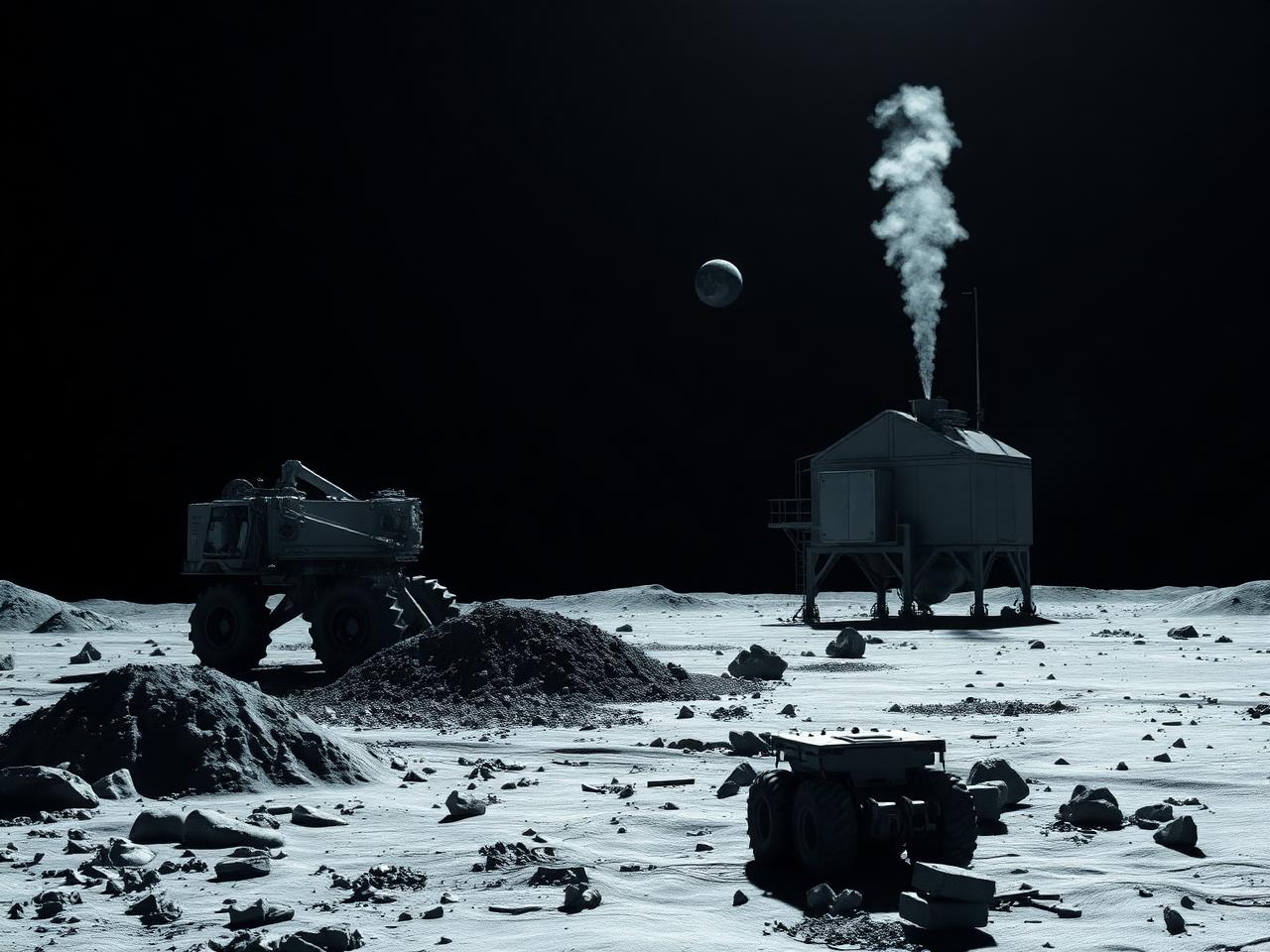
The tyranny of the launch ramp.
The rocket equation is unforgiving: to send mass to the Moon you must also launch the fuel to carry it, and the fuel to carry that fuel. By the time a payload reaches the lunar surface, it has cost many times its weight in propellant. Shipping water, air, and structural mass from Earth for a permanent presence is simply unaffordable.
The ratios are brutal. Reaching low Earth orbit consumes roughly nine kilometres per second of velocity change; getting from there to the lunar surface costs about six more. Each stage multiplies, so only a small fraction of what leaves the pad arrives intact. A crew consuming a few kilograms of water, oxygen, and food per person per day generates a resupply bill that grows linearly with mission duration and never stops.
ISRU flips the problem. Instead of carrying everything, a mission carries the machines that make what it needs from local material. The Moon is not a barren rock but a stockpile: regolith that is nearly half oxygen by mass, polar craters holding water ice, and metals bound in every shovel of soil.
The payoff compounds. Propellant made on the Moon can refuel vehicles heading deeper into the solar system, so the Moon becomes a filling station rather than a destination, and the cost of reaching Mars and beyond falls sharply. Because the Moon's escape velocity is about a twentieth of Earth's in energy terms, a tonne of lunar propellant delivered to cislunar space is worth far more than a tonne lifted from the ground.
What the Moon can supply, and how.
Four ways to pull oxygen out of the Moon.
Every oxygen-extraction route trades yield against temperature, power, and mechanical complexity. There is no universally correct choice, only the right match between a landing site, a power budget, and how many years the plant has to survive without a technician.
Hydrogen reduction of ilmenite
- Temp
- ~900 °C
- Input
- Ilmenite-rich regolith + recycled hydrogen
- Output
- Water, then oxygen after electrolysis
- Yield
- ~1 to 2% of feedstock mass as oxygen
The simplest chemistry and the best understood, but it works on only one mineral, so it needs beneficiation and it wastes most of the soil it handles.
Carbothermal reduction
- Temp
- ~1,600 °C
- Input
- Any regolith + recycled methane
- Output
- Carbon monoxide, then water, then oxygen
- Yield
- ~5 to 10% of feedstock mass as oxygen
Feedstock-agnostic and higher yield, using concentrated solar or laser heating to melt a small spot rather than a whole reactor.
Molten regolith electrolysis
- Temp
- ~1,600 °C
- Input
- Any regolith + electricity
- Output
- Oxygen gas plus molten metal alloy
- Yield
- Up to ~20% of feedstock mass as oxygen
The highest-yield route and the only one that produces structural metal as a co-product, but it demands durable anodes and continuous high power.
Thermal mining of polar ice
- Temp
- ~0 to 100 °C
- Input
- Icy regolith in shadowed craters
- Output
- Water, then hydrogen and oxygen
- Yield
- Depends on deposit, ~1 to 6% water by mass
Chemically trivial and energetically the cheapest per kilogram of water, but it requires working in permanent darkness at cryogenic temperatures far from sunlight.
From frozen crater to full fuel tank.
The flagship ISRU pipeline is water-to-propellant. Rovers prospect the permanently shadowed regions near the poles, where temperatures stay cold enough to trap water ice for billions of years. Once a deposit is mapped, thermal mining heats the soil just enough to sublimate the ice into vapor, which is drawn off and condensed into liquid water.
Prospecting is the step most people skip, and it is the one that decides everything downstream. Orbital neutron spectrometry can tell you hydrogen is present within a few tens of kilometres, but not whether it is concentrated ice, thin frost, or hydroxyl bound into mineral grains. Only ground truth, drilling and analysing cores metre by metre, converts a promising map into a mineable reserve. A plant sized for five percent water that lands on one percent ground is a stranded asset.
That water is then electrolyzed, split by electric current into hydrogen and oxygen. Liquefied and stored, those two gases are exactly the cryogenic propellants that power high-performance rocket engines. A lander that arrives empty can leave full, refueled entirely from material it never had to launch.
Storage is quietly the hardest link in the chain. Liquid hydrogen boils at 20 kelvin and leaks through almost anything, so cryocoolers must run continuously to keep boil-off near zero. Many architectures dodge the problem by making only oxygen locally, which is about four-fifths of propellant mass anyway, and importing the comparatively small hydrogen fraction from Earth.
A parallel pipeline works the dry regolith found everywhere on the surface. Molten regolith electrolysis melts the soil and passes current through it, liberating breathable oxygen while leaving behind iron, silicon, and other metals that can be cast or printed into hardware. Nothing is wasted; the leftovers of one process are the feedstock of the next.
ISRU is a power problem wearing a chemistry costume.
Oxygen on the Moon is not scarce, it is bound. Every extraction route is ultimately a way of spending energy to break a chemical bond that has been stable for four billion years. Estimates for molten regolith electrolysis cluster around 20 to 40 kilowatt-hours per kilogram of oxygen, so even a modest plant producing a few tonnes a year implies tens of kilowatts running continuously.
Continuously is the operative word. At most sites the lunar night lasts about 354 hours, and a plant that shuts down every two weeks loses its thermal state, wastes energy reheating, and cycles its hardware through the exact stresses that break it. Two answers exist: place the plant on a polar ridge with near-permanent sunlight, or bring fission power. Surface reactor programmes in the 10 to 100 kilowatt class are being developed for precisely this reason.
The uncomfortable geometry is that the best sunlight sits on high ground and the best ice sits in the dark craters below it. Bridging that gap with power cables, relocatable reactors, or shuttling icy regolith uphill is an unglamorous engineering problem that determines whether an entire architecture closes.
The chemistry is solved. The machinery is not.
Every reaction described here has been demonstrated in a terrestrial laboratory. What has not been demonstrated is running one for years, unattended, in vacuum, in one-sixth gravity, inside a cloud of the most hostile dust in the solar system.
Lunar dust has never been rounded by wind or water, so its grains stay sharp and glassy. It is electrostatically charged by solar ultraviolet, which makes it cling to every surface it touches. It abrades seals, jams bearings, coats radiators until they cannot reject heat, and dims solar panels. Apollo hardware degraded measurably over days; an ISRU plant must survive years.
Excavation is harder than it looks too. In one-sixth gravity a digger has little weight to push against, so machines must be anchored, ballasted, or redesigned to cut rather than shove. Regolith compacts into a dense, cohesive mass below the top few centimetres, and in shadowed craters it may be cemented with ice into something closer to concrete.
Then there is thermal cycling. Surface temperatures swing from roughly 120 °C in daylight to below -170 °C at night. Materials expand, contract, and eventually fatigue. Designing for that, with no maintenance crew and a repair turnaround measured in launch windows, is why autonomy and reliability matter more than peak efficiency.
When does making it beat shipping it?
ISRU is a capital-expenditure trade. You launch a plant, a power system, spares, and the mass of everything that installs it, then you produce for free, or rather for the price of maintenance and electricity. Break-even arrives when cumulative production exceeds the launched mass of the system that produces it.
That framing makes the answer obvious in both directions. A two-week sortie should bring its own supplies; no plant pays back in fourteen days. Anything measured in years inverts completely, because Earth resupply scales with time while plant mass does not. The crossover is the single most important number in a lunar business case, and it moves with launch cost, plant mass, and production rate.
There is a second-order effect that matters more than the first. A propellant depot in cislunar space does not just save money on the Moon, it changes what missions are possible anywhere beyond it. Vehicles can launch dry and fill up in space, which collapses the mass they need to lift from Earth. That is the difference between the Moon as a destination and the Moon as infrastructure.
Explural models these trade-offs directly. If you want to see how plant mass, power, and production rate interact, the interactive model is the fastest way in.
What has actually flown, and what is next.
ISRU stopped being theoretical in 2021. MOXIE, a toaster-sized unit aboard NASA's Perseverance rover, produced oxygen from Martian carbon dioxide across repeated runs until its campaign concluded in 2023. The quantities were small by design. The point was to prove that a machine on another world can manufacture a consumable, and it did.
Lunar evidence has been accumulating for longer. Lunar Prospector detected excess hydrogen at the poles in the late 1990s; the LCROSS impactor kicked up a plume from Cabeus crater in 2009 that contained water; the Lunar Reconnaissance Orbiter has been mapping surface temperature and hydrogen distribution ever since. Together they establish that the resource exists, without settling how concentrated or how accessible it is.
The near-term programme is prospecting hardware. Drills and mass spectrometers delivered under commercial lunar payload contracts are designed to sample volatiles directly from the subsurface at polar sites. Those results will decide siting for everything that follows, because you cannot design a plant until you know the ore grade.
The gap between prospecting and production is where the real work sits, and it is the gap Explural builds into: autonomous extraction systems that keep running long after the last crew has left.
Frequently asked questions about ISRU.
What does ISRU stand for?
ISRU stands for in-situ resource utilization: collecting and processing material found at a destination, such as lunar regolith or polar water ice, into water, breathable oxygen, rocket propellant, and construction material instead of launching those consumables from Earth.
How much oxygen is actually in lunar regolith?
Oxygen is the most abundant element in lunar soil. Apollo sample analysis puts it at roughly 40 to 45 percent of regolith by mass, chemically bound inside silicate and oxide minerals such as ilmenite, pyroxene, olivine, and anorthite. It is everywhere on the surface, but it is locked in minerals, so freeing it always costs energy.
Where is the water ice on the Moon?
Water ice is concentrated in permanently shadowed regions near the lunar poles, crater floors that have not seen sunlight for billions of years and sit near 40 kelvin. Neutron spectrometry from Lunar Prospector and LRO, plus the 2009 LCROSS impact into Cabeus crater, all point to hydrogen-rich deposits. Concentrations are patchy and typically measured in single-digit weight percent, not solid ice sheets.
How much energy does lunar ISRU require?
Energy is the binding constraint. Molten regolith electrolysis runs near 1,600 degrees Celsius and needs on the order of 20 to 40 kilowatt-hours per kilogram of oxygen produced. A plant making a few tonnes of oxygen a year therefore implies tens of kilowatts of continuous power, which is why ISRU architectures are inseparable from surface fission reactors or large solar arrays on polar ridges with near-constant illumination.
Is ISRU actually more economical than launching supplies from Earth?
It depends entirely on how long the operation runs. ISRU front-loads cost: you launch the plant, the power system, and the spares. Payback comes from cumulative production, so short sortie missions are better served by Earth supply while any presence measured in years crosses over decisively, because launched mass scales with time while plant mass does not.
What is the hardest engineering problem in lunar ISRU?
Regolith itself. Lunar dust is jagged, electrostatically charged, and abrasive because there is no weather to erode it. It grinds seals, clogs bearings, coats radiators, and degrades solar panels. Combined with the 14-day night, deep cold in shadowed craters, and no maintenance crew, the difficulty is not proving the chemistry but keeping the machinery running unattended for years.
Which ISRU technologies have actually flown?
MOXIE, an oxygen generator aboard NASA's Perseverance rover, produced oxygen from the Martian atmosphere across multiple runs between 2021 and 2023, the first demonstration of ISRU on another world. Lunar hardware remains pre-flight or in delivery: NASA's PRIME-1 drill and mass spectrometer and multiple CLPS-delivered payloads target prospecting and small-scale extraction.
Glossary and sources.
- Regolith
- The layer of fragmented rock and dust covering bedrock, produced on the Moon by billions of years of micrometeorite impacts rather than by weather.
- PSR
- Permanently shadowed region: a polar crater floor that never receives direct sunlight, cold enough to trap volatiles indefinitely.
- Ilmenite
- An iron-titanium oxide mineral (FeTiO₃) common in lunar mare basalt and the preferred feedstock for hydrogen-reduction oxygen plants.
- Beneficiation
- Sorting and concentrating raw regolith, usually magnetically or by grain size, so a reactor is fed useful mineral instead of bulk soil.
- Cislunar space
- The volume between Earth and the Moon, including lunar orbits, where a propellant depot would reset the cost of everything beyond it.
- TRL
- Technology readiness level, a 1 to 9 scale for how far a technology has progressed from concept to proven flight operation.
ISRU is the difference between visiting and staying.
Apollo visited; it brought everything and left almost nothing. A permanent presence cannot work that way. The mass budget only closes when habitats, propellant, and consumables come from the destination itself, which is why every serious lunar program now treats ISRU as foundational rather than optional.
The strategic prize is bigger than the Moon. Lunar-made propellant in cislunar space resets the economics of everything beyond it, crewed Mars transits, outer-system probes, and large structures assembled in orbit. The body with the most economical fuel depot becomes the hub of the solar economy.
At Explural, ISRU and fuel research advance together, prospecting the isotopes and volatiles that lunar soil holds, and engineering the autonomous extraction systems that turn raw regolith into the water, oxygen, and propellant a sustained presence depends on.
The Deep-Space Propulsion Primer.
A concise PDF reference covering every major propulsion class, chemical, electric, nuclear, and emerging concepts, with the thrust, efficiency, and trade-offs that decide which engine flies which mission. Enter your email to get the guide.
Keep exploring.
How space propulsion works: a complete guide
Chemical, ion, nuclear, and beyond, the engines that move spacecraft, explained from first principles.
Read →
Tritium vs. helium-3 for fusion energy
How the two leading fusion fuels compare on scarcity, yield, and why the Moon settles the debate.
Read →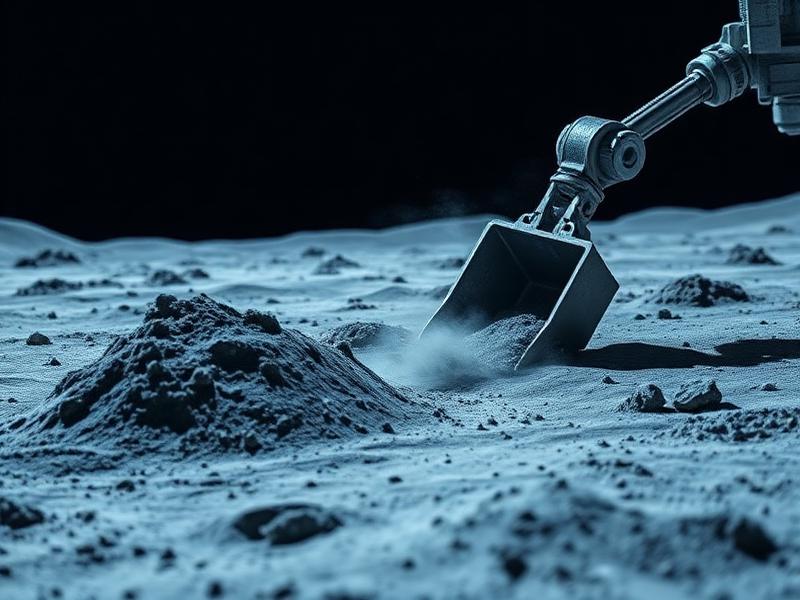
Extracting helium-3 from lunar regolith
The thermal volatilization process and the economics of mining fusion fuel from lunar soil.
Read →