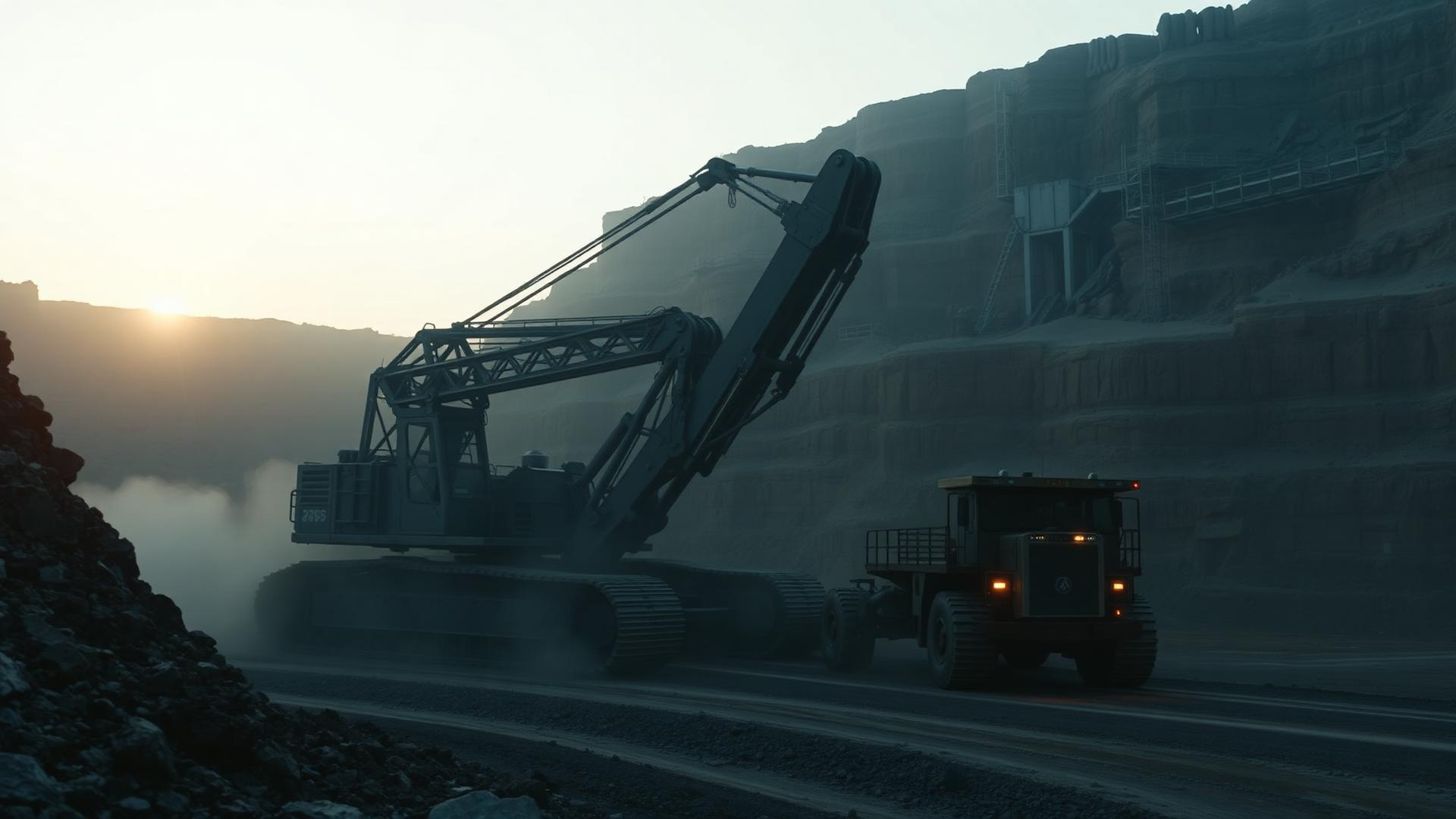
Autonomous excavation on Earth.
The space economy runs on materials that still have to be dug out of the ground. We are designing the AI-operated excavation and processing systems that supply critical minerals, metals, and feedstock on Earth, and prove the autonomy model before we take it off-world.
A pilot-scale operation to prove the supply chain can close.
Target
Critical-mineral deposits on Earth, rare earths, lithium, nickel, and cobalt, that feed propulsion, avionics, and structural supply chains for space hardware.
Objective
Demonstrate AI-driven excavation, sorting, and beneficiation at pilot scale to prove the autonomous systems that will later extract resources off-world.
Status
Concept stage. Seeking AI, robotics, and subsystem partners, plus seed investors to advance the program through design reviews and a pilot site.
Why excavation is the next autonomy bottleneck.
Launch costs are collapsing. Reusable rockets can deliver mass to orbit for a fraction of what it cost a decade ago. But the bottleneck is moving upstream: every spacecraft, satellite, and ground system is built from metals and minerals that are expensive to extract and unevenly supplied.
Rare earths, lithium, nickel, and cobalt sit at the base of the entire hardware stack, from magnets and batteries to alloys and structures. Secure them at lower cost and the economics of everything built on top improve.
Our program focuses on AI-driven excavation and beneficiation, the largest mass-flow, the highest energy demand, and the least automated step in the chain. Solve that on Earth, and the same control systems become the blueprint for extracting resources off-world, where the human operator cannot be in the loop.
From ore to refined feedstock in four stages.
AI-guided excavation & haulage
Robotic excavators and haul trucks plan their own paths, adapt to terrain, and run continuously. Removing the operator from the pit cuts cost per tonne and builds the control stack needed for remote lunar operations.
Sensor-based sorting
Ore is scanned with X-ray, hyperspectral, and computer-vision sensors and sorted grain by grain. Waste rock is rejected early, so only high-grade material moves downstream, slashing energy and water per unit of metal recovered.
Adaptive beneficiation
Crushing, grinding, and separation are controlled by machine-learning models that adjust in real time for ore variability. Tighter process control raises recovery rates and shrinks the tailings footprint.
Refining & feedstock output
Concentrate is refined into the metals and compounds that supply chains actually buy, the raw inputs for alloys, magnets, batteries, and structural components used across aerospace manufacturing.
Supply excavation and processing hardware.
We are looking for partners on robotic excavators, autonomous haulage, sensor-based sorting, and mineral processing. If you build or test hardware for mining and material recovery, we want to hear from you.
Supply excavation hardwareBack a lower-cost supply of critical minerals.
The path from concept to revenue runs through resource mapping, a pilot-scale site, and offtake agreements. Request the brief to see the thesis, the timeline, and where the numbers turn a profit.